
Sunset Music Journal
The Song Two Presidents’ Row Writers Couldn’t Quit
How a 1927 blues recording ended up scoring a Texas rib joint on House of Cards, a NASA monologue on The West Wing, and a spacecraft now further from Earth than anything else built by human hands.
Frank Underwood does not get rattled easily. That is the entire premise of his character, a man who narrates his own ruthlessness directly to camera without so much as a raised pulse. So when House of Cards wants to show him unguarded, actually unguarded, it does not reach for a monologue. It reaches for a record.
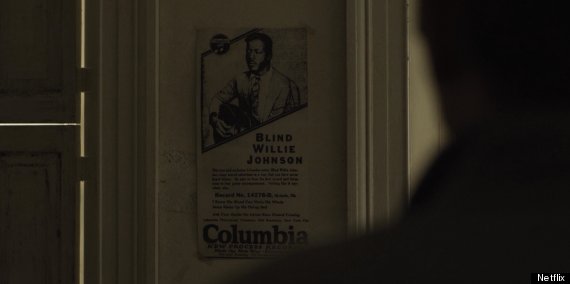
The scene happens at Freddy’s, the rib joint Frank treats as his one honest refuge in a city built on dishonest ones. A vintage poster of the blues musician Blind Willie Johnson hangs on the wall. Freddy pulls out a first pressing of “Dark Was the Night, Cold Was the Ground,” Johnson’s wordless, moaning slide guitar recording from 1927, and Frank looks at it and says, flatly, that the song gets him every time. It is one sentence. It does more character work than most shows manage in an entire episode.
The Track
Dark Was the Night, Cold Was the Ground — Blind Willie Johnson, recorded December 1927, released on Columbia in 1928. An instrumental gospel blues piece built almost entirely from slide guitar and wordless humming, with no lyric sheet standing between the listener and the feeling underneath it.
Here is the part that should matter to anyone who thinks seriously about music supervision, and it is the part House of Cards clearly understood: the song was never going to need lyrics to make its point. Johnson recorded it as pure texture, guitar and breath and grief, no words at all, which is exactly why a showrunner can drop it into a scene about a cold, calculating man and trust the audience to feel the temperature drop without a single line of dialogue explaining why. That is the whole art of a great needle drop. It does not illustrate the scene. It becomes the scene’s subtext, running underneath everything the actors are saying out loud.
“Dark Was the Night” gets me every time.
And the choice is not just tonally right, it is biographically loaded in a way that rewards a second watch. Johnson spent his final years living inside the burned-out ruins of his own house in Beaumont, Texas, after a fire destroyed it and left him with nowhere else to go. He caught a fever not long after, sleeping exposed to the damp and the ash, and no hospital in town would admit a blind Black street musician. He died there, in the wreckage, still playing when he could. A show about a man quietly setting fire to every relationship he touches, on his way to building an empire he will eventually watch crumble, could not have picked a more precise piece of foreshadowing if it had been written to order.
The West Wing Got There First
House of Cards was not actually the first serious American political drama to fall for this song, and the connection is too specific to be an accident. In The West Wing’s fifth season, in the episode “The Warfare of Genghis Khan,” Josh Lyman corners Donna Moss and delivers a full, detailed monologue about Blind Willie Johnson’s life, his blindness, his poverty, and the fact that NASA chose this exact recording, out of the entire history of recorded sound, to represent human loneliness to whatever might eventually find the Voyager spacecraft drifting somewhere past the edge of the solar system. When Josh finishes, Donna gets up and walks out of the room with three words: you got me. It is close enough to Frank Underwood’s line at Freddy’s that it reads less like coincidence and more like a quiet tip of the hat from one writers’ room to another, two very different shows agreeing on the same emotional shorthand.
Because here is the detail that makes both scenes land: Josh was not exaggerating for effect. “Dark Was the Night, Cold Was the Ground” really is one of twenty-seven musical selections pressed onto the Voyager Golden Record in 1977, sitting alongside Beethoven, Mozart, and Chuck Berry as humanity’s chosen soundtrack for deep space. Carl Sagan’s committee picked it specifically because a wordless blues instrumental crosses a language barrier that no lyric ever could. Grief and longing do not need translation. Voyager 1 is now over fifteen billion miles from home, the most distant human-made object in existence, and Blind Willie Johnson’s slide guitar is still riding along with it, further from Texas than Texas can even conceive of.
Why This Still Matters for Sync
We bring this one up at Sunset Music because it is a masterclass in something we talk about with clients constantly: the right piece of music does not need a big budget or a famous name attached to it to do serious emotional heavy lifting. Johnson never lived to see a royalty check that reflected what his music would eventually mean to the culture. But eighty, ninety years later, his six minutes of slide guitar are still getting cast in the most prestige-driven writers’ rooms in television, because the feeling in the recording has not aged even slightly. That is what a music supervisor is actually hunting for on every single brief that crosses a desk like ours. Not a hit. A feeling specific enough that no other track in the world would land the scene the same way.
It is also a reminder of something we tell every artist we work with. You do not get to choose which scene your song eventually scores, or which showrunner falls in love with it decades after you recorded it, or which spacecraft it ends up riding on. You only get to make the recording as honest as you can and let it go. Blind Willie Johnson made one of the most honest recordings in American music history in a room in 1927 with nothing but a guitar and a bottleneck slide, and it is still finding new rooms to haunt.
Have a track that could carry a scene like this one?
We’re reviewing submissions against four open sync briefs right now, spanning film, television, and advertising. Deadlines run through late August.
View Open Sync BriefsSyncs.
This week's sync requests, sorted by deadline. Read the brief, hit the reference, apply before the counter runs out.
Standing needs, open all year.
A library brief is worth more than a single sync slot — instead of one opportunity, your track goes into a catalogue that's pitched to hundreds or thousands of briefs over time, so it can place again and again with no extra work from you.
There's no fixed budget attached, since these tracks are licensed out repeatedly rather than sold once — you're paid each time a track gets used.