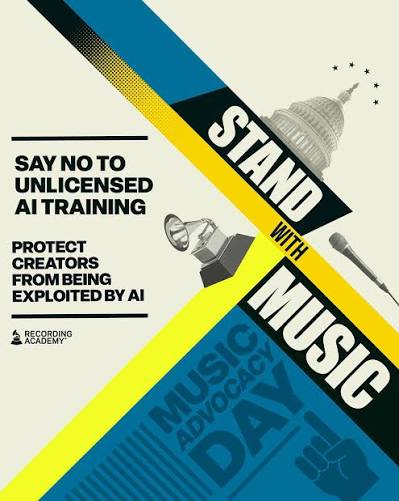
On Music Advocacy Day 2026, thousands of songwriters, performers and studio professionals walked into congressional offices across the country with a single message. Human creativity
Stand With Music: The Three Bills That Could Define the AI Era for Artists
On Music Advocacy Day 2026, thousands of songwriters, performers and studio professionals walked into congressional offices across the country with a single message. Human creativity deserves protection, credit and fair pay, and Washington has the tools to deliver all three.
Where the bills stand
NO FAKES Act
Federal right over your voice and likeness
Cleared Senate Judiciary unanimously June 18; fast-track passage blocked Sept. 30
TRAIN Act
Disclosure of AI training data
Introduced in House and Senate; awaiting committee action
Protect Working Musicians Act
Collective bargaining for independents
Introduced May 2026; referred to House Judiciary
Stages: Introduced · Committee · Floor vote · Second chamber · Signed into law
For one day each fall, the business of music leaves the studio, the stage and the boardroom and takes up residence in the local district offices of the United States Congress. On Thursday, October 8, the Recording Academy staged its twelfth annual Music Advocacy Day, and the thousands of members who took part arrived with a sharper agenda than in any year before. The question on the table was no longer simply how musicians get paid in a streaming economy. It was whether the people who create music will retain meaningful control over their voices, their catalogs and their livelihoods as generative artificial intelligence reshapes the industry at a speed few lawmakers anticipated.
The Academy built its 2026 campaign around three pieces of federal legislation, each addressing a different pressure point in that transformation. The NO FAKES Act would give every American a federal right over the use of their voice and visual likeness in AI-generated replicas. The TRAIN Act would give copyright owners a legal pathway to learn whether their work was used to train an AI model. The Protect Working Musicians Act would allow independent artists and songwriters to negotiate together with dominant streaming services and AI developers, something antitrust law currently discourages. Taken individually, each bill is a targeted fix. Taken together, they amount to the most coherent policy framework the creative community has yet presented for the age of machine-made media.
A Movement That Starts at Home
Music Advocacy Day has grown into the largest grassroots advocacy effort in the American music industry, and its design is deliberate. Rather than concentrating its members in Washington for a single afternoon of hallway lobbying, the Academy sends them to the home district offices of their own senators and representatives. A session drummer in Nashville, a film composer in Los Angeles, a jazz educator in New Jersey and a hip-hop producer in Atlanta each sit across from the staff who answer to their own constituents. That local framing matters. Lawmakers tend to treat national trade associations as one voice among hundreds, but they tend to listen closely when the person describing the stakes is a voter, a small business owner and a neighbor.
The model has proven durable. Over twelve years, Academy members have met with congressional offices in all fifty states, Washington, D.C. and Puerto Rico. The 2025 edition drew more than 2,100 participants across forty-five states, a record level of engagement, and the 2026 program extended that momentum into a political calendar crowded by midterm elections and a closing legislative session. Earlier in the year, the Academy marked the twenty-fifth anniversary of its GRAMMYs on the Hill program in Washington, and it closed the summer with a run of state and local campaigns. Days before this year’s Music Advocacy Day, the American Music Tourism Act cleared Congress, a reminder that sustained, patient advocacy can move legislation that once looked stalled.
What distinguished the 2026 effort was its singular theme. The Academy framed nearly every conversation around the protection of human creativity, a phrase that sounds abstract until one considers how quickly the economics of recorded music are changing. Synthetic vocals that mimic famous singers now circulate on social platforms within hours of release. AI systems capable of generating full compositions were built, at least in part, on vast libraries of copyrighted recordings whose owners were never asked and never paid. And independent musicians, who already struggle to command fair terms from a handful of global streaming companies, now face a second set of technology giants whose products may compete directly with their work. Music Advocacy Day 2026 asked Congress to address all three problems at once.
The NO FAKES Act and the Right to Your Own Voice
Of the three bills, the NO FAKES Act has traveled the furthest and drawn the broadest coalition. Its full name, the Nurture Originals, Foster Art, and Keep Entertainment Safe Act, signals its purpose. The bill would create a new federal intellectual property right that allows any individual, famous or not, to control whether a digital replica of their voice or visual likeness can be created and distributed. Under the proposal, producing or circulating an unauthorized AI clone would become actionable under federal law, and online platforms would be expected to remove infringing material once properly notified.
The idea has been in development since a discussion draft surfaced in 2023, and earlier versions stalled in committee. The current bill, introduced on May 20, 2026, as S. 4591 in the Senate and H.R. 8915 in the House, reflects years of negotiation. Its lead sponsors include Senators Marsha Blackburn of Tennessee and Chris Coons of Delaware, joined in the House by Representatives María Elvira Salazar of Florida and Madeleine Dean of Pennsylvania. The revised text adds a counter-notice process so that people whose content is wrongly taken down can respond, and it carves out explicit protections for news reporting, commentary, criticism and parody. Those changes were designed to answer free speech concerns that had slowed earlier drafts, and they helped bring a remarkably diverse set of supporters to the table, including record labels, entertainment unions, broadcasters in all fifty states, child safety advocates and several major technology companies.
The bill also builds on precedent. Tennessee’s ELVIS Act, signed in 2024 with the Academy’s support, became the first state law to protect performers against unauthorized voice cloning, and the NO FAKES Act would not override it. Federal lawmakers also point to the TAKE IT DOWN Act, which addressed nonconsensual intimate imagery, as evidence that Congress can legislate against AI misuse without stifling legitimate expression.
Your voice took a lifetime to build. The NO FAKES Act would make sure no one can manufacture it without your permission.
Sunset Music AdvocacyOn June 18, the Senate Judiciary Committee advanced the bill by unanimous voice vote, the first time any version of NO FAKES had cleared a committee in either chamber. That moment generated genuine optimism that the legislation could become law before the end of the year. The path then narrowed. On September 30, Senator Blackburn sought to pass the bill through unanimous consent, an expedited procedure that allows the Senate to approve legislation without a formal roll call but that any single senator can halt. Senator Ted Cruz of Texas objected, and with the Senate departing for its pre-election recess, the opportunity for quick passage closed. The objection did not kill the bill, but it changed the timeline, and it is precisely why the Academy’s members spent October 8 urging their representatives to finish the job before Congress adjourns. The bill remains on the Senate calendar, its committee support intact, and the lame-duck session after the midterms offers another window.
The TRAIN Act and the End of the Black Box
If the NO FAKES Act concerns what AI systems produce, the TRAIN Act concerns what they consume. Generative models learn by ingesting enormous quantities of existing material, and much of the music industry believes that copyrighted songs and recordings have been swept into those training sets without licenses or compensation. The difficulty for rights holders is proof. Developers rarely disclose the contents of their training data in detail, which leaves songwriters, publishers and labels unable to determine whether their work was used, let alone pursue payment.
The Transparency and Responsibility for Artificial Intelligence Networks Act offers a practical mechanism to change that. A copyright owner with a good-faith belief that their work was used to train a generative AI model could ask the clerk of a federal district court to issue a subpoena requiring the developer to produce training records sufficient to answer the question. The bill would add a new section to the Copyright Act to establish the process, and it is deliberately narrow, applying to generative models rather than every form of artificial intelligence. Senator Peter Welch of Vermont led the Senate version in July 2025 with Senators Blackburn, Adam Schiff of California and Josh Hawley of Missouri, a bipartisan roster that spans the ideological spectrum. In January 2026, Representatives Dean and Nathaniel Moran of Texas introduced the House companion as H.R. 7209.
Supporters describe the TRAIN Act as a transparency measure rather than a liability regime. It does not, by itself, declare any training practice unlawful. What it does is give creators the information they need to make that case or, more constructively, to negotiate licenses. Several states have moved in the same direction, with California requiring developers to publish summaries of their training data beginning in 2026, but a patchwork of state rules is a poor substitute for a single national standard. For the music business, the TRAIN Act could also accelerate the development of organized licensing markets for AI training, in which catalogs are cleared and compensated rather than quietly absorbed.
The Protect Working Musicians Act and the Question of Leverage
The third bill addresses an older problem that artificial intelligence has made more urgent. Independent musicians and small labels generally cannot band together to negotiate rates with the largest streaming platforms, because coordinated bargaining among competitors can expose them to antitrust liability. The result is a lopsided market in which a handful of dominant services set terms and the overwhelming majority of creators simply accept them. Major labels and large publishers have the scale to negotiate. Independent artists do not.
The Protect Working Musicians Act would carve out a narrow antitrust safe harbor allowing independent copyright owners to negotiate collectively, and even to collectively decline to license, when dealing with dominant online music distribution platforms and companies developing generative AI. Representative Deborah Ross of North Carolina reintroduced the bill in May 2026 as H.R. 8994, and it has been referred to the House Judiciary Committee. The concept first appeared in 2021 under former Representative Ted Deutch of Florida, focused on streaming royalties. When Representative Ross took up the cause in 2023, she added language covering AI developers, recognizing that the companies training music models would soon become some of the most important licensees in the business.
The bill enjoys deep support among the organizations that represent working musicians, including the American Association of Independent Music, the Artist Rights Alliance, the American Federation of Musicians, the Songwriters of North America, the Future of Music Coalition, the Authors Guild and the Recording Academy. Representative Ross has taken the case directly to the creative community, hosting a panel with musicians at a Raleigh venue and joining industry groups for a national online forum in August. Advocates describe the bill as a natural companion to the TRAIN Act. Transparency tells creators when their work is being used. Collective bargaining gives them the leverage to be paid fairly for it.
Transparency tells creators when their work is being used. Leverage determines whether they are ever paid for it.
Sunset Music AdvocacyThree Bills, One Philosophy
It would be easy to read the Academy’s agenda as a defensive crouch against new technology, but that interpretation misses its logic. None of the three bills bans artificial intelligence, restricts its development or prevents artists from using it. The NO FAKES Act permits digital replicas when the person being replicated agrees. The TRAIN Act requires disclosure, not prohibition. The Protect Working Musicians Act changes who sits at the negotiating table, not whether a deal gets done. The common thread is consent and compensation, the same principles that have governed music licensing for more than a century, extended into a medium that has so far operated largely without them.
That philosophy also explains the unusual breadth of political support. Republicans and Democrats have co-sponsored all three measures in various forms, and the coalition behind NO FAKES includes technology companies that recognize a stable legal framework is better for their businesses than an endless series of lawsuits and state-level experiments. The strongest objections have centered less on the goals of the legislation than on its details, including how broadly the new rights apply, how platforms handle takedown requests and how federal rules interact with competing priorities in Washington’s broader debate over AI regulation. Those are solvable questions, and the steady revision of each bill over successive sessions of Congress suggests that its sponsors are willing to solve them.
What Comes Next on Capitol Hill
The immediate focus is the post-election session. With midterm results settling the balance of power for the next Congress, the weeks between November and the end of the year represent the final opportunity for the current Congress to act before every pending bill expires and must be reintroduced. The NO FAKES Act is the most likely candidate for action, having already cleared committee with unanimous support and secured a place on the Senate calendar. Its sponsors could attempt another unanimous consent request, seek a negotiated arrangement that resolves the outstanding objection, or attach the bill to a larger legislative package. Each route depends on the kind of sustained constituent pressure that Music Advocacy Day was designed to generate.
The TRAIN Act and the Protect Working Musicians Act face longer horizons. Neither has yet received committee action, and both will likely need to be reintroduced in the new Congress in 2027. Their supporters regard that as an advantage as much as an obstacle, since a fresh session brings new members to educate, new committee leadership to engage and a growing body of evidence about how AI is affecting music markets. The groundwork laid this fall, in thousands of individual meetings between creators and congressional staff, is exactly the kind of preparation that tends to pay off when a bill is ready to move.
Why This Matters to Everyone Who Makes Music
For working professionals across the industry, these debates are not theoretical. Music supervisors, catalog owners, publishers and independent labels depend on clear rules about who controls a recording, who controls a voice and who gets paid when either is used. Every sync license, every catalog acquisition and every royalty statement rests on the assumption that ownership can be identified and enforced. Generative AI challenges that assumption at its foundation, and the three bills championed at Music Advocacy Day 2026 represent a serious attempt to restore it.
The Recording Academy’s members made their case in district offices from coast to coast this October, and the response from lawmakers of both parties has been encouraging. What remains is the hardest part of any legislative campaign, converting broad agreement into final votes. The creative community has done its homework, built its coalitions and refined its proposals. Now Congress has the opportunity to show that it can protect the people whose work gives American music its global reach. Sunset Music will continue to follow every step of that process and to stand with the songwriters, performers and producers whose creativity no machine can replace.