March 2026 is not just another awareness cycle—it’s a defining inflection point for music advocacy in the United States. What began decades ago as a grassroots effort to defend arts education has now evolved into a coordinated, high-impact national movement influencing federal legislation, reshaping industry accountability, and confronting the accelerating challenges posed by artificial intelligence. At the center of it all: Music in Our Schools Month (MIOSM), a renewed legislative push to secure equitable access to music education, and a wave of advocacy that is no longer content with symbolic gestures—it’s demanding structural change.
A National Stage for Music Education: MIOSM 2026 Reaches New Heights
This year’s Music in Our Schools Month arrives with unprecedented federal recognition. On March 5, 2026, concurrent resolutions were introduced in both chambers of Congress—H.Res.1108 in the House and S.Res.628 in the Senate—formally designating March as a national celebration of music’s essential role in education. This dual-chamber acknowledgment signals more than ceremonial support; it underscores a bipartisan understanding that music is not extracurricular—it is foundational.
Across the country, educators, administrators, and advocates are leveraging this momentum to elevate music education from enrichment to necessity. School districts are expanding programming, community organizations are amplifying outreach, and policymakers are being held accountable in real time. MIOSM 2026 is no longer about awareness—it’s about enforcement, investment, and permanence.
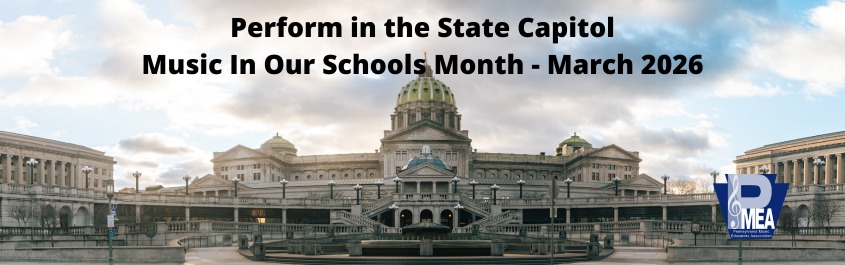
The advocacy momentum behind Music In Our Schools Month in March 2026 is not confined to federal policy or national campaigns—it is being brought directly into the public sphere through visible, community-driven performances like those organized by the Pennsylvania Music Educators Association (PMEA).
Throughout the month, PMEA is once again transforming the State Capitol building in Harrisburg into a living, breathing showcase of student musicianship and the real-world impact of music education. Concerts are scheduled to take place in the Main Rotunda from 12:00 pm to 1:00 pm, Monday through Friday, creating a consistent, high-profile platform where student ensembles can perform in one of the most symbolically significant civic spaces in the state.
This initiative is more than a performance series—it is strategic advocacy in action. By placing student musicians at the center of a government setting, PMEA is ensuring that legislators, policymakers, and the public are not just hearing about the value of music education—they are experiencing it firsthand. The acoustics of the Rotunda, combined with the steady flow of officials and visitors, create an environment where music becomes impossible to ignore, reinforcing its relevance in both cultural and legislative conversations.
Participation is structured to maximize opportunity and equity. Schools and ensembles are accepted on a first-come, first-served basis, with priority given to groups that did not perform the previous year. This approach broadens access, allowing more students across Pennsylvania to take part in a defining moment that connects their education directly to civic engagement.
In the broader context of Music In Our Schools Month 2026, PMEA’s Capitol concert series stands as a powerful example of localized advocacy driving statewide impact. It bridges the gap between policy and practice, demonstrating—clearly and convincingly—that music education is not an abstract concept, but a vibrant, essential force shaping students, schools, and communities in real time.
Federal Funding Secured: A Critical Win for Arts Education Nationwide
In a climate where arts funding has repeatedly been positioned on the chopping block, the passage of the Fiscal Year 2026 Labor–HHS–Education appropriations bill marks a decisive victory. Earlier proposals threatened to slash federal support for music and arts education by as much as 15 percent—cuts that would have disproportionately impacted underserved communities already fighting for access.
Instead, sustained advocacy efforts ensured that funding was not only preserved but stabilized, allowing programs across the country to continue operating without disruption. This outcome reflects a growing recognition in Washington that music education is directly tied to cognitive development, student engagement, and long-term academic success.
For districts that rely on federal support to maintain instruments, staffing, and curriculum infrastructure, this win is immediate and tangible. For advocates, it’s proof that coordinated pressure works—and that the narrative around arts funding is shifting from expendable to essential.
The GAAME Act Returns: A Legislative Blueprint for Equitable Access
Building on this momentum, advocacy groups are now rallying behind the reintroduction of the Guarantee Access to Arts and Music Education (GAAME) Act of 2026. This legislation is designed to close systemic gaps in access to high-quality music programs, particularly in low-income and historically marginalized communities.
The GAAME Act goes beyond funding—it establishes accountability. It aims to ensure that every student, regardless of zip code, has access to certified music educators, comprehensive curriculum, and the resources necessary to participate fully in music programs. In doing so, it reframes music education as a civil right rather than a privilege.
Support for the bill is rapidly gaining traction, with educators, artists, and industry leaders aligning behind a unified message: access to music education must be equitable, measurable, and protected at the federal level.
Industry Under the Microscope: Live Nation Antitrust Trial Begins
While education policy dominates one side of the advocacy landscape, the music industry itself is undergoing a historic reckoning. On March 2, 2026, jury selection began in the federal antitrust trial against Live Nation and Ticketmaster—a case that could fundamentally alter the structure of the live music ecosystem.
The Department of Justice, joined by 39 states, is pursuing action against what it alleges is anti-competitive vertical integration that has stifled competition, inflated ticket prices, and limited artist autonomy. At stake is not just corporate accountability, but the future of how live music is produced, distributed, and experienced.
For artists and fans alike, this trial represents a long-overdue challenge to a system that many argue has prioritized profit over accessibility. For advocates, it’s a reminder that music policy extends beyond classrooms—it reaches into every facet of the industry.
Protecting the Human Voice: AI Legislation Gains Urgency
As artificial intelligence continues to reshape the creative landscape, music advocates are intensifying efforts to protect the fundamental rights of creators. Central to this push is the NO FAKES Act, a proposed piece of legislation aimed at preventing the unauthorized use of artists’ voices and likenesses in AI-generated content.
This issue has rapidly escalated from theoretical concern to immediate threat. Deepfake vocals, synthetic performances, and unauthorized digital replicas are already challenging traditional definitions of authorship and ownership. Without clear legal protections, artists risk losing control over their most personal and valuable asset—their identity.
Events like Music Advocacy Day, led by the Recording Academy, have become critical platforms for educating lawmakers and mobilizing support. The message is clear: innovation must not come at the expense of integrity. The future of music depends on a framework that protects human creativity in an increasingly automated world.
Recognizing Champions: Advocacy in Action Awards Spotlight Leadership
Amid these large-scale policy battles, the impact of individual leadership continues to drive the movement forward. Music for All’s 2026 Advocacy in Action Awards have highlighted the educators, administrators, and community leaders who are transforming music education from the ground up.
These honorees represent the front lines of advocacy—those who are building programs, securing funding, and ensuring that students have access to meaningful musical experiences. Their work is a powerful reminder that while legislation sets the framework, it is people who bring it to life.
By elevating these voices, the awards reinforce a central truth: sustainable change in music education requires both top-down policy and bottom-up commitment.
Education Through Music Expands Its Reach in 2026
Few organizations exemplify this dual approach more effectively than Education Through Music (ETM). In 2026, ETM has not only expanded its programming but also strengthened its presence at the legislative level, securing new appointments and deepening its influence in policy discussions.
The organization’s growth is matched by its visibility. On March 28, ETM students will take the stage at the Inner Circle Show in New York City—a high-profile performance that underscores the transformative power of music education. These moments are more than showcases; they are statements of what is possible when access meets opportunity.
ETM’s continued expansion signals a broader trend: music education organizations are no longer operating on the margins—they are becoming central players in both cultural and political arenas.
Music as Advocacy: War Child Records Releases Help(2)
Advocacy is not confined to policy or education—it is embedded in the music itself. On March 6, 2026, War Child Records released Help(2), a powerful charity album featuring contributions from globally recognized artists including Olivia Rodrigo and Arctic Monkeys.
The project is both a creative endeavor and a humanitarian statement, raising awareness and funds for children affected by conflict zones around the world. It reflects a long-standing tradition of music as a vehicle for social change—one that continues to evolve in scale and impact.
By aligning major artists with urgent global issues, Help(2) reinforces the idea that music is not just entertainment—it is influence, responsibility, and action.
The Bigger Picture: A Movement Redefining Music’s Role in Society
What defines March 2026 is not any single initiative, but the convergence of multiple forces—education, legislation, industry accountability, and technological ethics—all moving in the same direction. Music advocacy is no longer fragmented; it is coordinated, strategic, and increasingly effective.
From classrooms to courtrooms, from Capitol Hill to global charity releases, the message is consistent: music matters, and its future is worth fighting for.
This moment is not the culmination of advocacy efforts—it is the acceleration. The policies being shaped, the cases being argued, and the protections being demanded today will define the next generation of music creators, educators, and audiences.
And for the first time in a long time, the movement is not reacting to change—it is driving it.