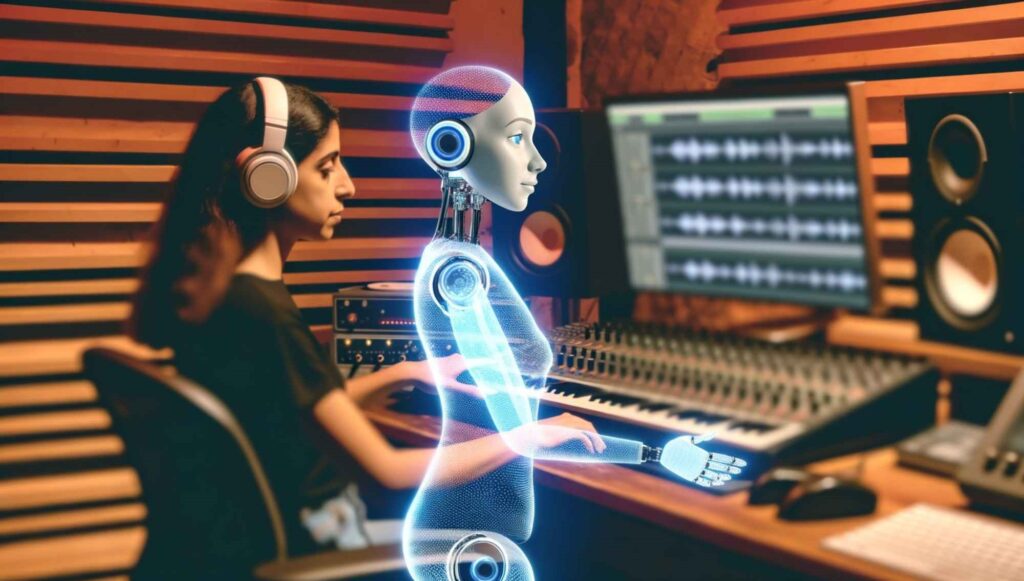
The AI music conversation in 2025 looks fundamentally different than it did even a year ago. What was once dominated by legal gray areas, unauthorized training data, and growing hostility between creators and technologists has begun to stabilize—driven largely by pressure from artists, labels, and advocates demanding accountability.
Today’s emerging AI music ecosystem is no longer defined by whether models can generate songs, but by how they are trained, who is compensated, and whether creators retain agency. The industry’s center of gravity has shifted toward licensed, transparent, and artist-aligned systems—marking a pivotal moment for music innovation and rights protection.
At Sunset Music Advocacy, we view this transition as necessary—but incomplete. Progress is real, but it must continue to prioritize musicians, songwriters, and rights holders at every stage.
From Lawsuits to Licenses: The Rise of Collaborative AI Music Platforms
Several high-profile AI music startups that once faced copyright litigation have now pivoted toward fully licensed frameworks, often through direct agreements with major label groups including Universal Music Group, Sony Music Entertainment, and Warner Music Group. These settlements are not merely legal footnotes—they represent a structural recalibration of how AI interacts with copyrighted sound recordings.
Klay Vision
Klay Vision has emerged as a bellwether for this new era. It became the first AI music company to secure licensing agreements across all three major label conglomerates. Its core initiative, a proprietary “Large Music Model” (KLayMM), is designed around active listening rather than passive generation.
Instead of spitting out finished tracks, Klay’s platform allows users to reinterpret licensed songs across styles, tempos, and arrangements—framing AI as a participatory tool rather than a replacement artist. While questions remain around attribution standards and downstream usage, Klay Vision’s licensing-first approach sets an important precedent.
Udio
Once emblematic of the unlicensed AI boom, Udio spent much of its early life entangled in copyright disputes. That chapter appears to be closing. In late 2025, the company reached a comprehensive settlement with major labels and announced a strategic overhaul.
Udio is now repositioning itself as a fan engagement and remix platform, with a subscription-based service scheduled to launch in 2026. Under this model, fans will be able to legally remix and interact with licensed catalog music—transforming remix culture from a legal liability into a sanctioned creative channel.
Suno
Suno’s agreement with Warner Music Group in November 2025 marked another inflection point. The company confirmed it will sunset its earlier, unlicensed training datasets and relaunch in 2026 with a model trained exclusively on WMG-owned and licensed audio.
This move acknowledges a core reality the AI sector can no longer ignore: models trained on unauthorized works are commercially and ethically unsustainable.
Ethical and Artist-Centric AI Tools: Moving Beyond “Replacement” Narratives
Not all innovation is coming from litigation settlements. A growing class of platforms is being built from the ground up with artist participation, revenue sharing, and creative control as foundational principles.
Aiode
Launched publicly in October 2025, Aiode positions itself as a virtual collaborator rather than a song generator. Instead of producing complete tracks, the system creates modular musical layers—melodies, harmonies, textures—that artists can integrate into their own work.
Crucially, Aiode shares revenue with musicians whose recordings contributed to the training process. This model reframes AI as a session player or co-writer, not a competitor.
Beatoven.ai
Through a partnership with Musical AI, Beatoven.ai introduced a fully licensed generative platform in late 2025. Its compensation structure mirrors modern streaming economics: rights holders are paid both for the use of their works in training and for AI-generated outputs derived from those models.
While not perfect, this dual-compensation approach represents a meaningful evolution in how training data value is recognized.
Mureka
Mureka takes a different approach entirely by allowing creators to train AI models exclusively on their own music. Artists upload their catalog, define stylistic parameters, and generate new material that reflects their personal sound.
This self-contained model avoids third-party rights conflicts and gives musicians unprecedented control over how AI extends their creative voice.
Established AI Creator Tools: Utility Without Exploitation
Alongside newer platforms, several established AI music tools continue to serve creators while minimizing copyright risk.
- AIVA remains a leader in orchestral and cinematic composition, offering professional users full copyright ownership of generated works—a critical distinction for film, television, and game scoring.
- Soundful caters primarily to marketers and content creators, providing a large library of royalty-free templates designed for commercial use.
- Soundraw avoids external artist datasets entirely, relying on original in-house content to power its system—an approach that trades stylistic breadth for legal clarity.
These tools underscore an important point: innovation does not require exploitation.
Why Music Licensing Still Matters—More Than Ever
Despite these advancements, music licensing remains one of the most complex and expensive challenges across festivals, film, gaming, and digital content. Clearance delays, opaque pricing, and fragmented rights ownership can derail projects before they ever reach an audience.
This is precisely why education and cross-industry dialogue are essential.
FESTFORUMS Drill Down: Music Licensing
At this year’s FESTFORUMS Drill Down, industry leaders will tackle the realities of modern music licensing head-on. Entertainment attorney and Tour Tech LLC CEO Tobi Parks, joined by Mike Ault, Director of Music Operations at Riot Games and Same Same But Different Festival, will unpack how licensing functions across live events, gaming, film, and digital media.
The session will focus on:
- Understanding the differences between synchronization, master use, performance, and mechanical licenses
- Strategies for securing affordable rights without sacrificing creative intent
- How emerging technologies are simplifying a historically burdensome process
- Navigating licensing in interactive and immersive environments
For festival organizers, filmmakers, content producers, and platform builders alike, the ability to navigate music rights is no longer optional—it is foundational.
The Hidden Costs of AI Music in 2025: What Artists and the Industry Are Paying For “Innovation”
The rapid expansion of AI music platforms in 2025 is often framed as an inevitability—an unstoppable wave of efficiency, automation, and creative democratization. But beneath the marketing language and venture capital optimism lies a growing list of consequences that disproportionately impact artists, listeners, and the long-term health of the music ecosystem.
At Sunset Music Advocacy, we believe technological progress must be evaluated not only by what it enables, but by what it erodes. As AI-generated music becomes more prevalent across streaming platforms, social media, and commercial content pipelines, the industry is confronting serious legal, economic, cultural, and ethical challenges that cannot be ignored.
Intellectual Property in Limbo: Who Owns AI Music?
Copyright Vulnerability
Under current U.S. copyright law, works created entirely by artificial intelligence are not eligible for copyright protection. That means many AI-generated tracks exist in a legal gray zone where users cannot claim exclusive ownership or control.
For artists and creators relying on AI tools, this creates substantial risk. Music generated through these systems can be copied, reused, or monetized by others without consent or compensation—undermining the very idea of creative ownership that copyright law was designed to protect.
Unlicensed Training Data
Many of today’s AI music models were trained on enormous datasets scraped from copyrighted recordings without permission from artists or rights holders. This practice has triggered major lawsuits from record labels and publishers against companies such as Suno and Udio, cases that could reshape the legal boundaries of AI training altogether.
While some platforms are now pursuing licensing agreements retroactively, the damage has already been done. Artists whose work was used without consent had no ability to opt out, negotiate compensation, or even know their music was being exploited.
Secondary Infringement Risks
The legal exposure does not stop with AI developers. Users themselves face risk when uploading AI-generated tracks that are deemed “substantially similar” to existing copyrighted works. Automated detection systems on streaming platforms may issue takedowns or copyright strikes—often without meaningful appeal processes.
In practice, this means artists and creators can be penalized for content they did not intentionally infringe, simply because an AI model replicated familiar melodic or structural patterns from its training data.
Economic Fallout: When Automation Undercuts the Creative Economy
Devaluation of Human Artistry
AI-generated music is attractive to platforms and advertisers because it is fast, cheap, and royalty-free. As a result, streaming services and content distributors may increasingly prioritize synthetic tracks over human-created music, shrinking the royalty pool available to working artists.
This shift does not eliminate demand for music—it reallocates revenue away from musicians and toward technology companies.
Job Displacement Across the Industry
Beyond artists themselves, AI tools are rapidly encroaching on roles traditionally filled by skilled professionals. Automated mixing, mastering, scoring, and production systems reduce opportunities for audio engineers, producers, composers, and session musicians—jobs that have long sustained the middle class of the music industry.
While proponents argue that “new roles will emerge,” there is little evidence that these jobs will match the scale, stability, or compensation of those being displaced.
Market Saturation and Discoverability Collapse
The ability to generate unlimited, professional-sounding tracks in seconds has already begun flooding digital platforms with synthetic content. As catalog sizes explode, independent human artists face an increasingly hostile discovery environment where visibility is dictated by algorithms rather than artistic merit.
In this landscape, originality becomes harder to surface, and listener attention becomes more fragmented than ever.
Artistic and Cultural Erosion
Replication Over Innovation
AI systems excel at pattern recognition, not lived experience. As a result, much AI-generated music leans toward imitation rather than genuine experimentation. Critics frequently describe these outputs as predictable, emotionally flat, or stylistically hollow—music that sounds correct, but feels empty.
True innovation has always come from cultural friction, personal struggle, and human context—elements no dataset can replicate.
Loss of Human Connection
Music has historically functioned as a bridge between artist and audience, grounded in vulnerability, storytelling, and shared experience. AI-generated music lacks personal narrative, lived history, and the energy of live performance—core elements that foster fan loyalty and cultural impact.
When music becomes purely functional, it risks losing its role as a connective art form.
Deepfakes, Voice Cloning, and Identity Theft
One of the most alarming developments is the rise of unauthorized voice cloning. Viral AI tracks that mimic recognizable artists without consent raise profound ethical questions around likeness rights, cultural appropriation, and personal identity.
For artists—particularly those from marginalized communities—this represents not only economic harm, but a loss of agency over their own voice and legacy.
Technical Limitations and Structural Bias
Limited Creative Control
Despite marketing claims, many AI music tools offer only surface-level customization. Predefined prompts and rigid parameters limit nuanced creative decisions, often resulting in overcompressed, sterile, or “synthetic” audio quality that lacks dynamic range and emotional depth.
For serious creators, these constraints quickly become a ceiling rather than a catalyst.
Cultural Bias in Training Data
Most AI music models are trained predominantly on Western pop and commercial datasets. As a result, they frequently struggle to authentically reproduce non-Western musical structures, rhythms, and tonal systems.
This bias reinforces cultural homogenization and sidelines global musical traditions that do not conform to dominant industry norms.
Why This Moment Matters
The rise of AI music is not inherently anti-artist—but the current trajectory is unsustainable without meaningful safeguards. Licensing, transparency, consent, and compensation must become baseline requirements, not optional features introduced after legal pressure.
At Sunset Music Advocacy, we are not opposed to technology. We are opposed to systems that extract value from artists without accountability, dilute cultural expression, and redefine creativity as a cost-saving mechanism.
The future of music depends on decisions being made right now. If innovation is allowed to outpace ethics, the industry risks losing the very human foundation that makes music matter.
Progress should elevate artists—not erase them.
The Path Forward
The AI music industry is at a crossroads. Licensing deals and ethical tools are encouraging signs, but true progress will be measured by long-term transparency, fair compensation, and artist consent—not press releases.
At Sunset Music Advocacy, we believe AI can coexist with human creativity—but only if creators remain at the center of the equation. The future of music technology must be built with artists, not on top of them.
The work is far from finished. But for the first time, the industry is moving in the right direction.